checkthis / Fact checks / Politics
The Reel says
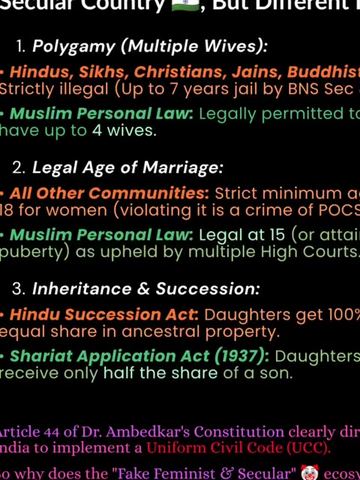
Fact-checking claims on Muslim personal law, non-Muslim laws, and Article 44?
The comparisons of personal laws governing polygamy, marriage age, and inheritance in India, alongside Article 44's Uniform Civil Code directive, are accurate. Under Indian statutes, monogamy and an 18-year marriage age apply to non-Muslims, while Muslim personal law allows polygamy and recognizes puberty for marriage, though recent High Court decisions hold that laws like the PCMA and POCSO override personal law. Under the 2005 Hindu Succession Act amendment, daughters inherit equal shares, whereas the Shariat Application Act generally allocates female heirs half the share of males. Article 44 directs the State to endeavour to secure a Uniform Civil Code for all citizens.
- 6 claims checked
- 8 sources
- Checked 10 Nov 2026
- Main source: Polygyny in India - Wikipedia
 ▶
The Reel we checked
@asal_sangathi
If the same criminal code applies to every citizen regardless of religion, why does a "secular" democracy still allow separate religion-based laws for marriage…
Watch on Instagram ↗What we checked
What the Reel doesn't tell you
- Article 44 of the Indian Constitution, listed under Directive Principles of State Policy (Part IV), directs the State to endeavour to secure a Uniform Civil Code for all citizens, though Directive Principles are non-enforceable in court (Constitution of India).
- High Courts in India have expressed divergent views on minor marriages under personal law, with recent rulings from the Allahabad High Court and Delhi High Court holding that statutory prohibitions on child marriage (PCMA) and sexual offences (POCSO) override personal laws (The Hindu, India Today).
- The Supreme Court is examining petitions challenging gender disparities in inheritance under the Shariat Application Act, 1937, while observing that enacting a UCC falls within Parliament's legislative domain (The Hindu, New Indian Express).
Short version
Does this look wrong?
Related checks
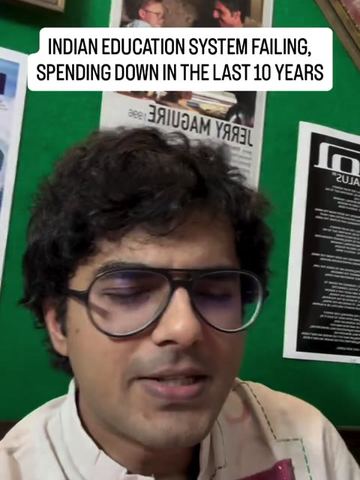
Education spending and school closure claims rely on conflated metrics@nishantmittal2410 · Politics · 11 Nov 2026
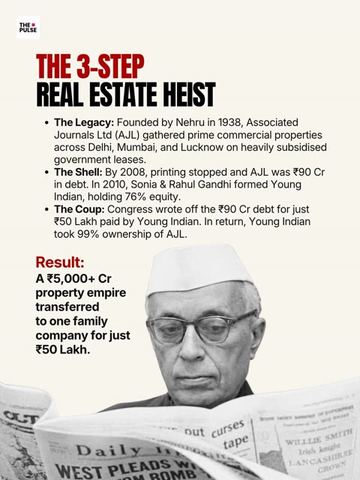
Did the Gandhi family execute a ₹5,000-crore real estate heist via Young Indian?Politics · 11 Nov 2026
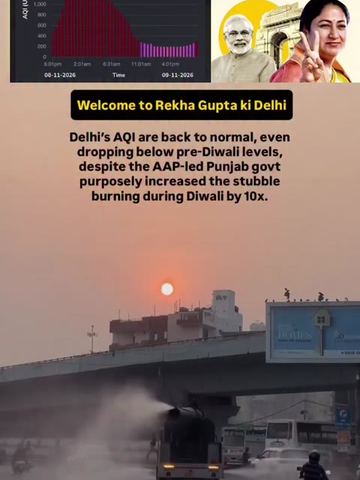
False claim that Delhi's AQI returned to normal after Diwali@newpama_ · Politics · Trick: Exaggerates · 10 Nov 2026
Check a Reel yourself
Send any Reel to @checkthis.chat on Instagram. You get a reply like this in a minute or two.
Send a Reel